INSTRUMENTAL PROGRAM
How to Apply to the Instrumental Program
Chamber Music Studies
Guidelines for submitting audition recordings
Strings (general admission and Orchestral String Fellowship requirements)
Winds, Brass, Percussion and Harp (general admission and fellowships)
American Academy of Conducting at Aspen Fellowship
Orchestral Woodwind, Brass, Harp, or Percussion Fellowship
Introduction
As an instrumentalist, your Aspen experience may include orchestral performances, private lessons, chamber music studies, elective music-related courses, and the chance to compete in student competitions, the winners of which will perform a solo with orchestra.
It is important that students be aware that we are, by design, a full-session program. We strongly encourage applicants to apply for the full eight weeks, as orchestral and chamber music participation for half-session instrumentalists may be extremely limited.
Private Lessons
Acceptance to the Aspen Music Festival and School is contingent upon being accepted into an artist-faculty member's studio. Applicants designate three teachers of choice on the application form and will study weekly with their assigned teacher. Please note that audition recordings are not necessarily reviewed by all three requested teachers.
Click here for the most current artist-faculty listing and biographies.
Solo Opportunities
Students are welcome to participate in a series of student competitions, the winners of which are invited to perform with one of the orchestras during the summer. Students may only participate in competitions with the written consent of their teachers, and previous winners are not eligible to compete. A full schedule of competition and performance dates will be mailed to accepted students in the spring.
The Spotlight, String Showcase, and Open Door recital series also provide solo opportunities for students. Students may participate with permission from their teachers and the series coordinator.
Courses
All students are encouraged to participate in the music-related courses offered by the AMFS artist-faculty and staff. In addition, the AMFS offers courses in body awareness, including Alexander Technique. College credit is available for some courses. Click here to see a full list of course offerings.
Orchestras
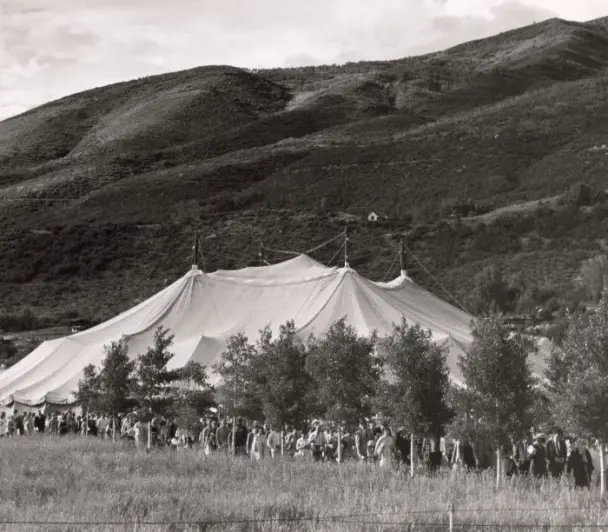
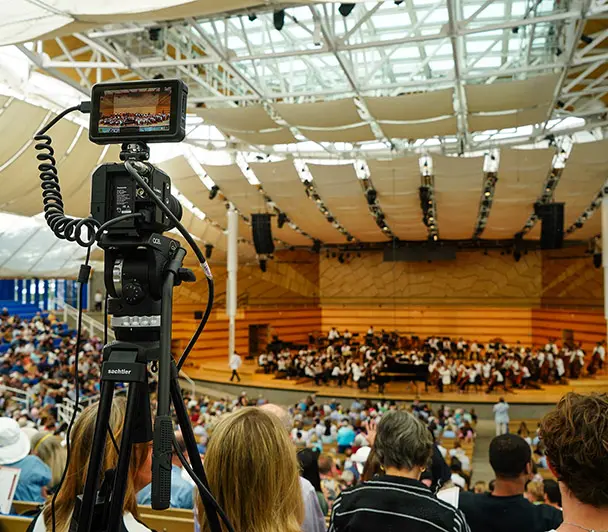
Aspen maintains four performing orchestras, each of which plays in the Benedict Music Tent. Auditions for orchestral placement are held upon arrival in Aspen. Wind, brass, percussion, and harp players may rotate through different orchestras throughout the eight weeks. String players are generally placed in one orchestra for the season. Conductors and soloists for AMFS orchestras are some of the finest artists on the concert circuit today. The orchestras, in alphabetical order, follow.
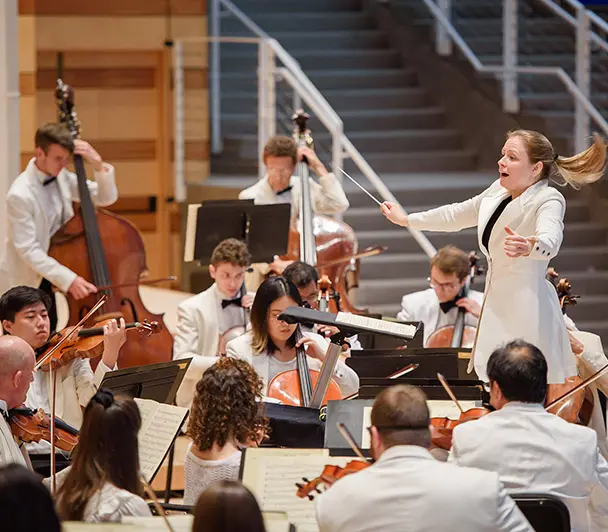
The American Academy of Conducting at Aspen Orchestra is the centerpiece of a program directed by AMFS Music Director David Zinman that is the country's premier institution for training young conductors. The orchestra is guided by both master conductors and the next generation of up-andcoming conducting talents, who perform in the orchestra when off the podium. Activities include weekly orchestral concerts, concerto performances, opera scenes master classes, repertoire readings, film scoring readings, and a family concert. For more information on this program, click here.
The Aspen Chamber Symphony is composed of AMFS artist-faculty members and students, and is led by world-renowned conductors and joined for most concerts by guest soloists. Repertoire consists of standard and contemporary works for the chamber symphony.
The Aspen Concert Orchestra is a large symphony orchestra. Concerts are directed by world-renowned guest conductors and artist-faculty of the Aspen Music Festival and School. The ensemble provides its members with an important opportunity to continue to develop their orchestral playing skills while rehearsing and performing major orchestral works.
The Aspen Festival Orchestra is composed of AMFS artist-faculty members and students and is led by world-renowned conductors and joined for most concerts by guest soloists. Repertoire consists of standard and contemporary works from the symphonic literature.
CHAMBER MUSIC Opportunities
Bärli Nugent, director
The Aspen Music Festival and School's chamber music program is built around myriad student ensembles studying a wide range of repertoire prepared in coachings and master classes by more than forty artistfaculty members, guest artists, the American Brass Quintet and—schedules permitting—members of the resident string quartets.
While auditioning for chamber music in Aspen is optional, students accepted into the program must demonstrate professional initiative and responsibility in their weekly coaching sessions and all assigned performances. Student ensembles focus primarily on traditional configurations—string quartets; piano trios, quartets, and quintets; and wind and brass quintets. Chamber music auditions take place during registration in Aspen; string, woodwind, and piano students must prepare required repertoire. Students are encouraged to bring their own chamber music scores and parts, as a supplement to the repertoire in the AMFS chamber music library.
Performance opportunities abound for Aspen's many student ensembles, including a chamber music series at Aspen Chapel, COMPLINK, the Day of Music, the Composer's Forum, outreach concerts, Chamber House Music concerts, Spotlight Recitals, and Benedict Music Tent fanfares. In addition to performance opportunities, there are weekly coaching classes, public master classes, piano and strings classes, and concerts by resident and visiting ensembles.
The 2010 ensembles-in-residence will include the American Brass Quintet, American String Quartet, Ying Quartet, and Takács Quartet.
Brass Quintet Opportunity
The AMFS sponsors three fellowships and two full scholarships to a preformed brass quintet for the eight-week program. The quintet will perform on two recitals with the American Brass Quintet, receive coachings and lessons from ABQ members, and its individual members will be part of the regular orchestra rotation.
To apply, send a group resume and a recording (live or studio) that includes the first movement of the Victor Ewald Quintet in B-flat (first quintet), and at least two other contrasting pieces.
Send all materials by January 4, 2010 to:
John Rojak,
25 Cimarron Road
Putnam Valley, NY 10579.
Once a group is chosen, each individual must immediately complete the application for admission and send it to the Office of Student Services. Group members may also apply as individual students to the AMFS.
Please note: There is no application fee for students applying solely for the brass quintet opportunity. However, if a student chooses to apply as an individual student for the AMFS program, the student must follow the "instrumental" application procedure and application fees will apply.
How to Apply to the Instrumental Program
All items to be submitted together. All materials, including recordings, will not be returned.
- Due Date: January 4, 2010
(Apply early for discounted application fee.)
- All items to be submitted together:
- Completed application and financial assistance application
- Application Fee
- FOUR COPIES of your audition DVD (strings only) or CD (all other instruments), as noted in your instrumental area (see below).
- Current resume
- Be sure all items on the Application Checklist have been completed.
In addition to the above requirements, students are strongly encouraged but not required to send two letters of recommendation, which may be used in the scholarship process.
Follow these guidelines when submitting audition recordings
Recordings are a required part of the application process for all students, new and returning. They are used by artist-faculty members to select students for their private studios and to make scholarship recommendations. Acceptance to the Aspen Music Festival and School is contingent upon acceptance into a private studio.
- DVDs (strings only) and CDs (all other instruments) must be compatible with U.S. playback equipment.
- Recordings will not be returned. Please do not send originals.
- Videotapes, DATs, minidiscs, and cassettes will not be accepted.
Note: DVDs (strings only) and CDs (all other instruments) should be of the highest-possible artistic and audio quality. Applicants should play the pieces straight through with pauses only where they belong and with no artificial reverberation. Please record all orchestral excerpts under the same conditions, i.e. location and microphone distance.
Labeling instructions
- Label the discs and spines of ALL cases with your name and instrument using a permanent marker (even if the spine is narrow).
- Write the track listings on the jewel-case cover or directly on the disc itself.
- Each disc must be packaged in its own jewel case or sleeve.
Instrumental Program repertoire requirements for audition recordings
STRINGS (General admission and Fellowships)
String players have numerous playing opportunities including orchestra, chamber music, solo appearances, weekly private lessons with an artist-faculty member, coaching sessions, and master classes. Approximately three-fourths of all AMFS students receive financial assistance, based on talent and demonstrated financial need. Please see repertoire requirements and instructions on how to apply:
VIOLIN, VIOLA, CELLO
- Two or three pieces in contrasting style, approximately 15 minutes in length
BASS
- Two or three pieces in contrasting style, approximately 15 minutes in length, and two contrasting orchestral excerpts of your choice
ORCHESTRAL STRING FELLOWSHIP
Schedule a live audition online.
Violin Fellowship Requirements
- MOZART: Violin Concerto No. 4 in D major, K. 218 (1st movement exposition only) OR MOZART: Violin Concerto No. 5 in A major, K. 219 (1st movement exposition only)
- 1st movement of a major concerto (in addition to the Mozart concerto above)
- R. STRAUSS: Don Juan, op. 20 (beginning to twelve measures after Reh. C) (first page)
- BEETHOVEN: Symphony No. 7, (1st movement, pick-up to m. 89 to the downbeat of m. 130)
- PROKOFIEV: Symphony No. 1 in D major, op. 25, "Classical", (1st movement, beginning to five measures after Reh. 3 (measures 1-32))
Viola Fellowship Requirements
- Your choice of any movement of an unaccompanied Bach suite (excluding Preludes)
- 1st movement of a major concerto
- MENDELSSOHN: A Midsummer Night's Dream, op. 61 (Scherzo: Reh. B to Reh. D)
- R. STRAUSS: Don Juan, op. 20 (m. 1-8; and pick-up to m. 21 to m. 48)
- BERLIOZ: Roman Carnival Overture, op. 9 (up-beat to three measures after Reh. 1 through Reh. 4)
Cello Fellowship Requirements
- Your choice of any movement of an unaccompanied Bach suite (excluding Preludes)
- Any movement of a major concerto
- BRAHMS: Symphony No. 3 in F major, op. 90, (3rd movement, m. 1-16)
- DEBUSSY: La mer (Reh. 9 to six measures before Reh. 10; top divisi line)
- R. STRAUSS: Don Juan, op. 20 (m.1-49)
Bass Fellowship Requirements
- Your choice of any dance movement from an unaccompanied Bach suite (excluding Preludes)
- BRAHMS: Symphony No. 2 in D major, op. 73 (4th movement, m. 244-279)
- MOZART: Symphony No. 35 in D major, K. 385, "Haffner" (4th movement, m. 134-181)
- R. STRAUSS: Ein Heldenleben (A Hero's Life), op. 41 (Reh. 9 to the first measure of Reh.11)
2010 ORCHESTRAL STRING FELLOWSHIP AUDITION DATES
Schedule a live audition on or after November 2, 2009.
Ann Arbor - Saturday, January 30
Baltimore - Wednesday, January 20
Bloomington - Wednesday, January 20
Boston - Sunday, January 31
Boulder - Thursday, January 14
Chicago - Friday, January 15
Cincinnati - Tuesday, January 19
Cleveland - Sunday, January 31-Monday, February 1
Houston - Wednesday, February 3
Los Angeles - Monday, January 25
New York - Saturday, January 16-Sunday, January 17
Philadelphia - Tuesday, January 19
Rochester - Thursday, January 28
San Francisco - Tuesday, January 26
WINDS, BRASS, PERCUSSION, AND HARP (General admission and Fellowships)
All woodwind, brass, percussion, and harp applicants must submit FOUR copies of their audition CDs.
Instrumentalists have numerous playing opportunities including orchestra, chamber music, solo appearances, weekly private lessons with an artist-faculty member, coaching sessions, and master classes. Approximately three-fourths of all AMFS students receive financial assistance based on talent and demonstrated financial need.
Fellowship students receive tuition, room, and board in AMFS facilities, and may take advantage of the full AMFS curriculum. Students who choose not to reside in AMFS facilities receive a stipend of $2,750 for the whole session. All fellowship students will be assessed the health service fee ($175) and the security deposit ($100).
Fellowships in the areas of flute, oboe, clarinet, horn, trumpet, trombone, and percussion are chosen from the general pool of applicants; auxiliary instruments have specific repertoire requirements. See below for all repertoire requirements. There are no live auditions for woodwind, brass, percussion or harp applicants, including fellowship applicants.
Prepare only the following repertoire for audition CDs.
Note: Applicants should play the pieces straight through with pauses only where they belong and with no artificial reverberation. Please do not speak on the recording.
FLUTE AND FLUTE FELLOWSHIP
- MOZART: Flute Concerto in G major, K. 285c (K. 313) (1st movement) or MOZART: Flute Concerto No. 2 in D major, K. 314 (1st movement)
- A French conservatory piece (i.e. Fauré or Enescu)
- BEETHOVEN: Leonore Overture No. 3, op. 72b (m. 328-360)
- BRAHMS: Symphony No. 4 in E minor, op. 98 (4th movement, m. 97-105)
- MENDELSSOHN: A Midsummer Night's Dream, op. 61 (Scherzo, two before Reh. P to end)
- RAVEL: Daphnis et Chloé, Suite No. 2 (three after Reh. 176 to two after Reh. 179)
PICCOLO FELLOWSHIP
On flute
- MOZART: Flute Concerto in G major, K. 285c (K. 313) (1st movement) or MOZART: Flute Concerto No. 2 in D major, K. 314 (1st movement)
- A French conservatory piece (i.e. Fauré or Enescu)
- BEETHOVEN: Leonore Overture No. 3, op. 72b (m. 328-360)
- BRAHMS: Symphony No. 4 in E minor, op. 98 (4th movement, m. 97-105)
- MENDELSSOHN: A Midsummer Night's Dream, op. 61 (Scherzo, two before Reh. P to end)
- RAVEL: Daphnis et Chloé, Suite No. 2 (three after Reh. 176 to two after Reh. 179)
- VIVALDI: Piccolo Concerto in C major, RV 443 (1st movement)
- BERLIOZ: Dance of the Sprites from La damnation de Faust, op. 24 (Presto after Reh. 9)
- RIMSKY-KORSAKOV: Scheherazade, op. 35 (4th movement, m. 17 to 8 after Reh. V)
- TCHAIKOVSKY: Symphony No. 4 in F minor, op. 36 (3rd movement, Scherzo, two after Reh. E to Reh. G and 4th movement, m. 3 to 12 after Reh. H)
- RAVEL: Daphnis et Chloé, Suite No. 2 (three after Reh. 156 to two after Reh. 159)
- SHOSTAKOVICH: Symphony No. 6 in B minor, op. 54 (three measures after Reh. 8 to the third beat at Reh. 10)
OBOE AND OBOE FELLOWSHIP
- Two solo pieces and three standard orchestral excerpts
ENGLISH HORN FELLOWSHIP
On English horn
- BERLIOZ: Roman Carnival Overture, op. 9 (beginning to modulation)
- DVORAK: Symphony No. 9 in E minor, op. 95, "From the New World" (2nd movement, principal solo)
- FALLA: The Miller's Dance from The Three-cornered Hat (solo)
- ROSSINI: Overture to William Tell (solo)
CLARINET AND CLARINET FELLOWSHIP
- MOZART: Clarinet Concerto in A major, K. 622 (3rd movement to m. 222)
- NIELSEN: Clarinet Concerto, op. 57 (the two cadenzas only)
- BRAHMS: Symphony No. 3 in F major, op. 90 (1st movement, m. 36-46)
- BEETHOVEN: Symphony No. 8 in F major, op. 93 (3rd movement, trio including repeat)
- PROKOFIEV: Peter and the Wolf (Nervoso, Reh. 20 to 21)
- RAVEL: Daphnis et Chloé, Suite No. 2 (third bar of Reh. 212 to the end of the piece)
- SIBELIUS: Symphony No. 1 in E minor, op. 39 (3rd movement, six after Reh. E through six after Reh. G)
Second and E-Flat Clarinet Fellowship
Applicants should prepare all of the repertoire required of clarinet applicants, plus:
- RAVEL: Bolero (Reh. 3 to Reh. 4)
- BERLIOZ: Symphonie fantastique, op. 14 [5th movement, Allegro, for 26 measures (Reh. 63 to 5 after Reh. 64)]
- SHOSTAKOVICH: Symphony No. 5 in D minor, op. 47 (2nd movement, Reh. 49 to 5 after Reh. 50 and Reh. 53 to 1 after Reh. 54)
- SHOSTAKOVICH: Symphony No. 6 in B minor, op. 54 (2nd movement, Reh. 34 to Reh. 37)
- RAVEL: Piano Concerto in G major (1st movement, Reh. 18 to Reh. 19 and 9 before Reh. 35 to Reh. 35; and 3rd movement, Reh. 1 to six after Reh. 1)
- RAVEL: Daphnis et Chloé, Suite No. 2 (one before Reh. 157 to Reh. 161, Reh. 200 to six after Reh. 203, and Reh. 214 to four after Reh. 220)
BASS CLARINET FELLOWSHIP
Applicants should prepare all of the repertoire required of clarinet applicants, plus:
On bass clarinet
- MEYERBEER: Les Huguenots [5th Act (cadenza starting on clarion F)]
- SCHUMANN: Symphony No. 3 (toccata section solo to m.170)
- KHACHATURIAN: Piano Concerto (2nd movement solo, 220 to low C)
- GROFÉ: Grand Canyon Suite [section 3 ("On the Trail") from Reh. 2 to Reh. 3]
BASSOON AND BASSOON FELLOWSHIP
- MOZART: Bassoon Concerto in B-flat major, K. 191 (1st movement, exposition only)
- STRAVINSKY: The Rite of Spring (opening)
- RIMSKY-KORSAKOV: Scheherazade, op. 35 (2nd movement, solo plus the cadenzas)
- RAVEL: Bolero (solo)
- TCHAIKOVSKY: Symphony No. 4 in F minor, op. 36 (2nd movement, solo)
CONTRABASSOON FELLOWSHIP
On contrabassoon
- RAVEL: Mother Goose Suite (solo)
- RAVEL: Piano Concerto for Left Hand in D major (solo)
- BEETHOVEN: Symphony No. 5 in C minor, op. 67 (4th movement, Allegro, m. 374-464)
- J. S. BACH: Suite No. 1 for Unaccompanied Cello in G major, BWV 1007 (Gigue)
SAXOPHONE FELLOWSHIP
- PROKOFIEV: Suite No. 2 from Romeo and Juliet, op. 64ter
- RAVEL: Bolero
HORN AND HORN FELLOWSHIP
Choose one selection from each bullet, for a total of four items.
- 1st movement only from any of the following MOZART Concerti: Horn Concerto No. 2 in E-flat major, K. 417; Horn Concerto No. 3 in E-flat major, K. 447; or Horn Concerto No.4 in E-flat major, K. 495
- RAVEL: Piano Concerto in G major; BEETHOVEN: Symphony No. 7 in A major, op. 92 (1st movement); WAGNER: from Gotterdammerung (Siegfried's Short Call)
- SHOSTAKOVICH: Symphony No. 5 in D minor, op. 47 (1st movement, low tutti); BEETHOVEN: Symphony No. 3 in E-flat major, op. 55, "Eroica" (Scherzo trio, second horn); R. STRAUSS: Don Quixote (Variation VIII, second horn, six measures before Reh. 59 to eight measures after Reh. 62)
- MAHLER: Symphony No. 3 in D minor (opening tutti); R. STRAUSS : Ein Heldenleben (one measure before Reh 78 to one measure after Reh 79)
TRUMPET AND TRUMPET FELLOWSHIP
- One movement of a concerto or sonata, one etude, and two standard orchestral excerpts; these contrasting selections should demonstrate technical facility and lyrical style.
TENOR TROMBONE AND TENOR TROMBONE FELLOWSHIP
- Two movements in contrasting style (fast, slow)
- MOZART: "Tuba mirum" from Requiem, K. 626
- ROSSINI: Overture to The Thieving Magpie
- RAVEL: Bolero
BASS TROMBONE
- Two contrasting solo movements (fast, slow)
- Three orchestral excerpts
TUBA
- BRUCE BROUGHTON: Tuba Concerto (2nd movement)
- BERLIOZ: Symphonie Fantastique, op. 14 (4th movement, Reh. 56 to six measures after Reh. 57; 5th movement, five measures before Reh. 85 to Reh. 86; 5th movement, four measures before Reh. 86 to end);
- MAHLER: Symphony No.1 in D major, (3rd movement, four measures before Reh. 3 to Reh. 4)
- PROKOFIEV: Symphony No. 5 in B-flat major, op. 100 (1st movement, Reh. 3 to two measures after Reh. 5; 1st movement, two measures before Reh. 14 to three measures after Reh. 17)
- RESPIGHI: Fountains of Rome (pick up to Reh. 11 to Reh. 14)
- WAGNER: Prelude to Die Meistersinger von Nürnberg (Reh. J to Reh. L)
TUBA FELLOWSHIP
Applicants should prepare all of the repertoire required of tuba applicants, plus:
- BERLIOZ: Le corsaire Overture, op. 21 (Reh. 5 to ten measures after Reh. 5 and four measures after Reh. 12 to downbeat of Reh. 13
- WAGNER: Prelude to Act III from Lohengrin (Reh. B to three measures before Reh. C and six measures after Reh. D to two measures after Reh. E)
- WAGNER: Eine Faust Overture (measures 1-3)
PERCUSSION AND PERCUSSION FELLOWSHIP
Please do not speak on the recording. Click here for more information about the Charles Owen Memorial Fellowship, for which all full-session percussion applicants are eligible.
On snare drum
- J. DELECLUSE: Etude No. 10, from 12 Studies for Snare Drum
- RIMSKY-KORSAKOV: Scheherezade, op. 35 (3rd movement, Reh. D-Reh. E. and Reh. F-Reh. H; 4th movement, Reh. P-Reh. R)
On timpani
- HOCHRAINER: Etuden fur Timpani, Vo. 2, # 50
- BEETHOVEN: Symphony No. 7 in A major, op. 92 (1st movement, m. 89-110; 4th movement, m. 413 to the end)
- HINDEMITH: Symphonic Metamorphosis after Themes by Carl Maria von Weber (2nd movement, Reh. S-T; and two measures before Reh. Z to the end)
On xylophone
- GERSHWIN: Overture to Porgy and Bess (main passage with strings only)
- W. SCHUMAN: Symphony No. 3 (main passage)
- KODÁLY: Háry János Suite (6th movement, all passages)
On marimba or vibraphone
- Solo of your choice (approximately 3-8 minutes in length)
HARP (All harp applicants must submit FOUR copies of their audition CDs.)
- Solo of your choice, 6-8 minutes in length
- TCHAIKOVSKY: from Nutcracker, op. 71 (Cadenza)
- BRITTEN: from Young Person's Guide to the Orchestra (Variations and Fugue on a Theme of Henry Purcell), op. 34 (Cadenza)
- VERDI: Overture to La forza del destino (Reh. G to Reh. O)
- R. STRAUSS: Don Juan, op. 20 (beginning to Reh. G and Reh. L to Reh. N)
Harp Fellowship
Applicants should prepare all of the above repertoire plus:
- Cadenza of your choice
- DONIZETTI: from Lucia di Lammermoor (Scena e Cavatina)
- BRUCH: Scottish Fantasy, op. 46 (1st movement, Reh. E to Reh. H; 3rd movement, Reh. B to Reh. C; and 4th movement, beginning to Reh. C)
BACK TO TOP