Convocation 2026

06

On Monday June 29, Munroe President and CEO Alan Fletcher gave his annual Convocation address, as he enters his 21st and final season with the AMFS. His message about the place of the arts in a society, the meaning of success, grit, love, and the need the world has for artists was greeted with a heartfelt and extended ovation. We share these remarks, below.

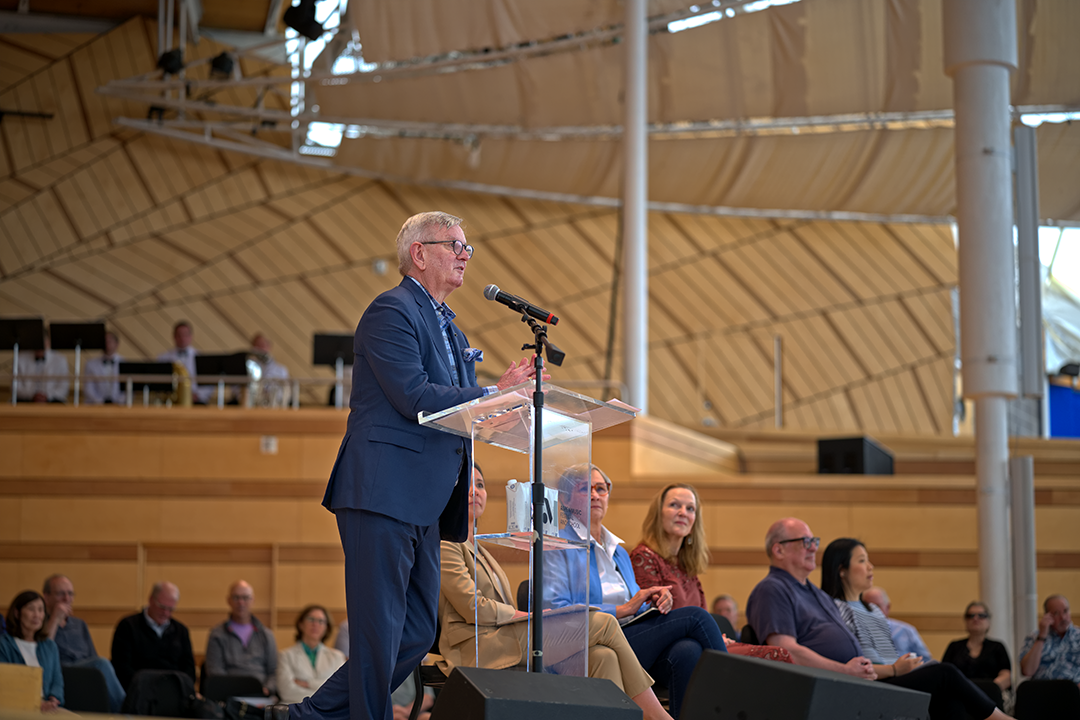
Fletcher speaks in the Klein Music Tent; Looking on (left to right) are AMFS VP and Dean of Students Azusa Chapman, Aspen Mayor Rachael Richards, and AMFS Board Chair Alexandra Munroe, Wall Family Music Director Robert Spano, and pianist and Aspen alumna Joyce Yang.
Photo Credit: Pablo Causa

In May 1780, in the middle of the American Revolution, when everything was unknowable and threatening, John Adams wrote this celebrated passage to Abigail Adams:

The science of government it is my duty to study, more than all other sciences; the arts of legislation and administration and negotiation ought to take the place of, indeed exclude, in a manner, all other arts. I must study politics and war, that our sons may have liberty to study mathematics and philosophy. Our sons ought to study mathematics and philosophy, geography, natural history and naval architecture, navigation, commerce and agriculture, in order to give their children a right to study painting, poetry, music, architecture, statuary, tapestry, and porcelain.

To paraphrase: things are terrible, and some things matter more than others, and we can only concentrate on one thing, so that later, when things are better, we can have nice things. Or put another way: we need to do the hard stuff first, and the arts are the easy stuff.

One hesitates to contradict so profound and eloquent a patriot as John Adams, but I would propose that, in this matter, he was deeply mistaken.

It’s worth noting, by the way, that he wasn’t making only one mistake. He talks only of sons. Four years earlier, when John Adams was drafting the Declaration of Independence, Abigail Adams had written to him urging that he should “Remember the Ladies… in the new Code of Laws which I suppose it will be necessary for you to make.” But he and his colleagues forgot the ladies, and it would be more than 140 years before women even had the right to vote in the United States.

Anyway, let’s think about the idea that one has to have priorities, and war comes first, then natural science, and finally, the arts.

The calamitous 14th century was the time of the Great Famine, the Hundred Years War, the Black Death, and the Great Schism of the church. These were really bad things. It was also the time of Dante and Giotto. An age that seemed to have no perspective on its own endless conflict bequeathed to us the art of perspective, and Dante's literary vision of order and beauty has transcended the strife and despair of every century since. Giotto brought us the Renaissance and Dante essentially brought us Italy and Italian as we know it. That is what we remember about their time. The arts are what still live.

Which matters more today - the pietistic theology of the German 18th century, which literally governed the lives and deaths of countless people, or the music of J.S. Bach? If we even think about that theology, it is in order better to understand Bach: we don’t study Bach to learn more about Germany. Bach lives in us, and we live better thanks to him.

We don’t gather together all over the world to think about how Napoleon tried to impose his code on all of Europe, but we do gather, hundreds of years later, and build concert halls, and fund orchestras, to listen to Beethoven’s Eroica.

Closer to our own time, when this country experienced the Great Depression, did we give up the arts because people were hungry and desperate? No - we needed the arts; they were literally a way out of hardship, a way to keep going, and thousands of Americans were employed to make art, to be a witness to their time, to record what was happening, and to dream about what might happen next.

To those who lived under the Soviet Russian government, poetry and music had supreme importance. No hardship, and no oppression, could prevent them from expressing themselves and communicating their message to each other, and to the future.

Thus, I would say to John Adams: the study of the arts must be undertaken everywhere and at all times - more when it is difficult than less, more when society seems unprepared for it than less, more when it requires a sacrifice than less. The arts are not a decoration for a society rich and stable enough to afford it. They are at the core of the definition and meaning of what society is, and why it is worthwhile.

This is our contribution as artists: the gift of the beautiful, the impractical, the visionary, the critical, the worrisome, the celebratory, the improbable, the if-only. The world-changing strengths of engineering and science, politics and philosophy, are complemented and completed by the world-encompassing strengths of the arts, with their resistless challenge. The sciences need the arts.

The arts at all times are deeply communicative. We speak not only to each other, but, through the medium of memory, with the past. We study history because our creations are a dialogue with our sisters and brothers who were artists since humans became humans. An extraordinary project in this Aspen summer will be Sarah Kirkland Snyder’s opera “Hildegard,” dramatizing the life and work of St. Hildegard of Bingen. Hildegard risked her life to express her vision, and her work was so important and her charisma so great that she is the first person in our musical tradition to be known by name. Before her, all composers are “Anonymous!” Just as the Han dynasty painters of China, or Olmec sculptors of Mexico, or Egyptian architects, or Athenian playwrights speak to us, though from the distant past, with clear and fresh voices, we understand that we ourselves are speaking directly to the future - a thrilling responsibility.

The key thing is that we must know each other and talk to each other. We must support each other and encourage each other. Musicians need a lot of time alone, and we spend a lot of time separated in rehearsal rooms, but the point of it all is to be sharing, to be part of a community, to be intrinsic to a community.

Some years ago, Jessye Norman was our guest here in Aspen. We asked her to speak to our opera students and staff - singers, technical people, pianists, coaches, teachers. We expected a story about her struggles and the brilliant successes that followed them, bits of advice from the height of her achievement that would inspire us. Something like, "Some day, if you work hard enough, you might be like me!"

But this was the day after Beverly Sills had died, and Jessye Norman instead said, “I want to talk about my friend.” Beverly Sills triumphed over immense personal difficulties, yet she presented an unfailingly positive and generous face to the world. She radiated incomparable technique and artistry with an appearance of ease and grace that was especially meaningful to those who knew how hard things really were for her. But more than that, when the moment came for her to retire from the stage, when she would never again have whatever happiness her triumphs in performance had brought her, she turned to a life of service for music and musicians. Jessye Norman said, "Be a wonderful musician, but also be a true citizen! Volunteer in your community: do something for other people. It isn’t about you. When you are helping someone, say to yourself: 'I am a musician,' with pride and conviction."

Success - excellence - is not a matter of surpassing others - it is a matter of making a surpassingly important contribution.

Two months after he wrote that letter to his wife about needing to take care of business before getting to the arts, John Adams did a very different thing. He and a few friends, now believing that they might win the war and establish a new country, founded an organization that still exists, to bring together political and business leaders with scientists and artists. The American Academy of Arts and Sciences has as its mission “to cultivate every art and science which may tend to advance the interest, honor, dignity, and happiness of a free, independent, and virtuous people.”

Now, the founders of this country were saying a very different thing: we need thinkers, dreamers, artists and scientists, if we are going to have honor, dignity, and happiness. In a nice detail, last year the Academy posthumously elected Abigail Adams as a member, since she could not have joined in 1780.

When I was eleven years old, and studying music as if my life depended on it, but not knowing if I was good enough or would ever make a difference to anybody, I got into some kind of argument at home, and did an eleven-year-old thing, running up to my room to be as sad and alone as possible. My father came up and came into my room and sat there for a while, silently. He could have said a lot of reasonable things, including “Stop it" or “Just grow up.” Instead, he said the most wonderful thing, something I remember now years later, when he is gone. After a long, companionable silence, he said: “We need you.”

And that is what I say to all of you, everyone who is working to make music happen in the world, no matter how or where: “We need you.”

Just this past weekend, I was at an extraordinary dinner party here in Aspen. Among the guests were a very well-known thinker and commentator on politics, and an immensely important historian who is a filmmaker. In our conversation, they both agreed that no one ever talks about love any more – the idea that love is at the heart of what we do and how we do it is now absent. But another person there, a musician, said, “Everything we do in our world is about love and through love, and we talk about it all the time!”

Be proud of your work in music. Be convinced that it is worthwhile. Learn everything you can from those who WANT you to learn, and then turn around and give it back to others. Be someone who is completely tied into a community. Talk to people different from you. Listen to people different from you. The world needs you, now.

09